
Hey there! As a brake press supplier, I often get asked about the maximum bending angle of a brake press. It's a crucial question, especially for those in the metal fabrication industry. So, let's dive right in and explore this topic in detail.
First off, what exactly is a brake press? Well, it's a machine used to bend sheet metal. It works by clamping the workpiece between a punch and a die. The punch then applies force to bend the metal to the desired angle. Brake presses come in various sizes and types, each with its own capabilities.
Now, the maximum bending angle of a brake press can vary quite a bit. It depends on several factors, including the type of brake press, the material being bent, and the thickness of the material.
Types of Brake Presses and Their Impact on Bending Angle
There are mainly two types of brake presses: mechanical and hydraulic.
Mechanical brake presses use a flywheel and a clutch to generate the force needed for bending. They are generally faster and more precise for light to medium - duty applications. The maximum bending angle of a mechanical brake press typically ranges from 0 to 135 degrees for most standard models. However, some high - end mechanical brake presses can achieve angles up to 180 degrees. This is great for applications where you need to create simple bends in thinner sheets of metal, like in the production of CNC Aluminum Sheet Metal Bending Forming Brackets. These brackets often require sharp, precise bends, and a mechanical brake press can do the job efficiently.
Hydraulic brake presses, on the other hand, use hydraulic cylinders to apply force. They are more powerful and can handle thicker and tougher materials. The maximum bending angle of a hydraulic brake press can go from 0 to almost 180 degrees. In fact, many industrial - grade hydraulic brake presses are designed to achieve a full 180 - degree bend. This makes them ideal for heavy - duty applications, such as the production of Precision CNC Bending Sheet Metal Fabricated Parts OEM ODM. These parts often need complex bends and can be made from thicker metals, which a hydraulic brake press can handle with ease.
The Role of Material in Bending Angle
The type of material being bent also plays a huge role in determining the maximum bending angle. Different metals have different properties, such as ductility and hardness.
For example, aluminum is a very ductile metal. It can be bent to a relatively large angle without cracking. You can easily achieve angles close to 180 degrees when bending thin aluminum sheets using a suitable brake press. This makes aluminum a popular choice for many metal - bending applications, especially in industries like aerospace and automotive, where lightweight and easily - formed materials are needed.
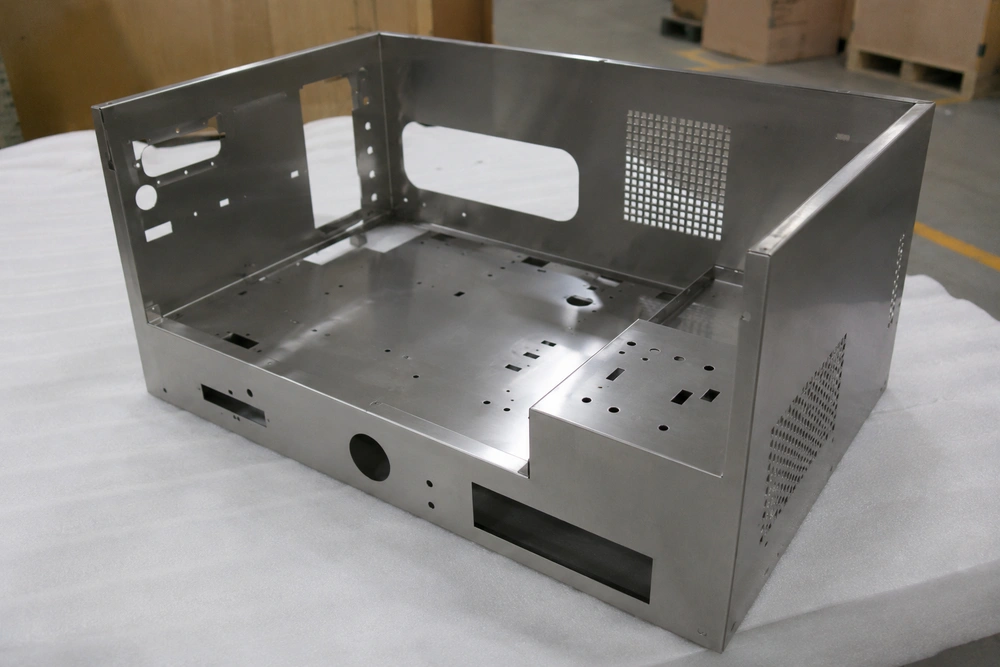
Stainless steel, on the other hand, is much harder and less ductile than aluminum. When bending stainless steel, the maximum bending angle may be limited. For thinner stainless steel sheets, you might be able to achieve angles up to 135 degrees, but for thicker sheets, the angle could be even less. If you're looking to produce Custom Stainless Steel Bending Sheet Metal Forming Parts, you need to take into account the hardness of the stainless steel and choose the right brake press accordingly.
Thickness of the Material
The thickness of the material is another important factor. Thicker materials require more force to bend and are more likely to crack or deform if bent at too large an angle.
For very thin materials, like sheets less than 1mm thick, you can usually achieve a wider range of bending angles, approaching 180 degrees in many cases. As the thickness increases, the maximum bending angle decreases. For example, a 3mm thick steel sheet may only be bent to around 90 - 120 degrees, depending on the type of brake press and the steel's properties.
How to Determine the Right Bending Angle for Your Project
So, how do you figure out the maximum bending angle for your specific project? Here are some steps:
- Know your material: Research the properties of the metal you're using. Look up its ductility, hardness, and other relevant characteristics. This will give you an idea of how far you can bend it without causing damage.
- Consider the thickness: Measure the thickness of your material accurately. Thicker materials will require more force and may have more limited bending angles.
- Choose the right brake press: Based on your material and thickness, select the appropriate type of brake press. If you're working with thin, ductile materials, a mechanical brake press might be sufficient. But for thicker, tougher materials, a hydraulic brake press is probably your best bet.
- Test and adjust: Before starting a large - scale production run, do some test bends. Try different angles and observe how the material responds. Make adjustments as needed to achieve the best results.
The Importance of the Right Bending Angle
Getting the right bending angle is crucial for several reasons. Firstly, it ensures the structural integrity of the final product. If the metal is bent at an incorrect angle, it may not fit properly into the assembly, leading to weak joints and potential failures.
Secondly, it affects the aesthetics of the product. In industries where appearance matters, such as architecture and furniture design, the right bending angle can make a big difference in the overall look of the finished piece.
Lastly, it impacts the efficiency of the manufacturing process. If you try to bend the metal beyond its limits, you may end up with scrap material, which increases costs and reduces productivity.

Conclusion
In conclusion, the maximum bending angle of a brake press depends on multiple factors, including the type of brake press, the material being bent, and the thickness of the material. As a brake press supplier, I'm here to help you choose the right machine for your specific needs. Whether you're working on CNC Aluminum Sheet Metal Bending Forming Brackets, Precision CNC Bending Sheet Metal Fabricated Parts OEM ODM, or Custom Stainless Steel Bending Sheet Metal Forming Parts, I can provide you with the best solutions to achieve the perfect bending angle.
If you're interested in learning more about our brake presses or have a specific project in mind, don't hesitate to reach out. We're here to assist you in making the right choices for your metal - bending needs. Let's start a conversation and see how we can work together to take your projects to the next level.
References
- Metal Fabrication Handbook
- Sheet Metal Bending Guidebooks