
Sheet Metal Fabrication Services: Complete Guide to Custom Metal Parts Manufacturing
Introduction
Sheet metal fabrication is a versatile manufacturing process used to transform flat metal sheets into functional components, enclosures, brackets, frames, panels, housings, and complex assemblies. From industrial machinery and electrical equipment to transportation systems and custom OEM products, fabricated sheet metal parts are essential across a wide range of industries.
However, successful sheet metal manufacturing involves much more than simply cutting and bending metal.
Part quality, production cost, dimensional consistency, assembly performance, and lead time can all be influenced by decisions made during the early stages of a project. Material selection, sheet thickness, bend radius, hole placement, welding method, tolerance requirements, surface finishing, and production quantity must be considered together.
CustomizedFab provides custom sheet metal fabrication services for industrial and OEM projects, supporting customers from drawing review and manufacturing planning through cutting, forming, joining, finishing, inspection, packaging, and delivery.
Our manufacturing capabilities include design and engineering support, laser cutting, CNC punching, CNC bending, rolling, deep drawing, TIG welding, MIG/MAG welding, spot welding, blind rivet installation, stud welding, clinching, deburring and chamfering, grinding and polishing, tapping, drilling and reaming, surface finishing, assembly support, supply chain integration, warehousing and packaging.
This guide explains how sheet metal fabrication works, which processes are available, how materials and design decisions affect manufacturing, what buyers should include in an RFQ, and how to evaluate a fabrication partner for prototype and production projects.
1. What Is Sheet Metal Fabrication?
Sheet metal fabrication is a group of manufacturing processes used to convert flat metal sheets into finished parts or assemblies.
A typical fabrication project may involve engineering drawing review, material selection, sheet cutting or punching, bending or forming, welding or mechanical joining, secondary machining, deburring and edge treatment, surface finishing, assembly, quality inspection, packaging, and delivery.
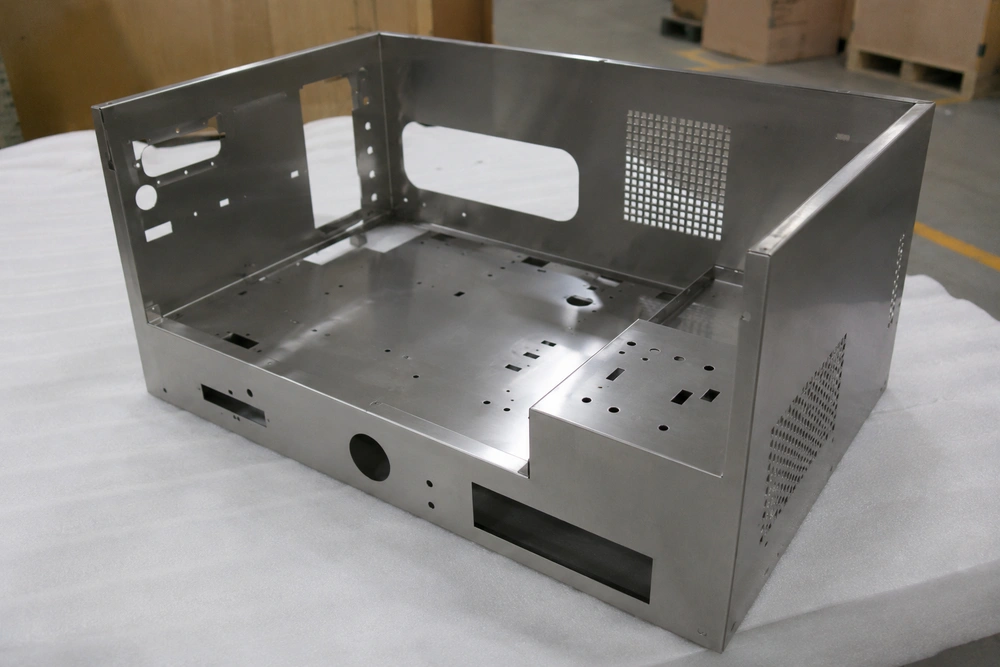
Unlike a single-process manufacturing method, sheet metal fabrication often combines multiple operations. For example, a custom electrical enclosure may require laser cutting for the flat blank, CNC punching for ventilation patterns, CNC bending for walls and flanges, spot welding for internal structures, stud welding for mounting hardware, grinding for visible weld areas, powder coating for corrosion resistance and appearance, and final dimensional inspection before packaging.
This integrated workflow is one reason why supplier capability is important. A project may experience unnecessary delays, tolerance problems, or inconsistent quality when too many operations are transferred between unrelated subcontractors.
2. Our Sheet Metal Fabrication Process
A reliable fabrication workflow should begin before production starts. At CustomizedFab, a typical project can move through drawing and requirement review, design for manufacturability review, process planning, production, inspection, finishing, packaging, and delivery.
During drawing review, customers may provide STEP, DXF, DWG, PDF engineering drawings, 3D CAD models, 2D manufacturing drawings, material specifications, surface finishing requirements, inspection standards, and packaging instructions.
Important manufacturing details may include material grade, sheet thickness, overall dimensions, bend angles, bend radii, hole sizes, hole-to-edge distances, hole-to-bend distances, welding symbols, critical tolerances, cosmetic surfaces, surface finish, and assembly requirements.
Design for Manufacturability, commonly called DFM, is especially valuable for custom sheet metal parts. Typical DFM considerations include bend radius relative to material thickness, holes positioned too close to bend lines, narrow slots, small internal features, unnecessary tolerance requirements, difficult welding access, distortion-prone welded structures, excessive numbers of unique bends, complex tooling requirements, surface finish compatibility, and assembly sequence.
The purpose of DFM is to identify opportunities to improve manufacturability while maintaining the required function.
3. Material Cutting Services

Cutting is usually one of the first physical production stages after material preparation. CustomizedFab supports different cutting methods according to part geometry, material, thickness, quantity, and cost requirements.
Laser cutting is widely used for precision sheet metal components because it can produce complex profiles directly from digital manufacturing data. Typical applications include brackets, panels, enclosure blanks, machine covers, mounting plates, structural components, and custom OEM parts.
Laser cutting is particularly useful when a project requires complex 2D geometries, flexible production quantities, fast design changes, repeatable profiles, and reduced dedicated tooling. Common materials include stainless steel, carbon steel, mild steel, aluminum, and other project-specific sheet metals.
Laser cutting is often suitable when the part has a complex outer profile, multiple holes or slots are required, dedicated stamping tooling is not justified, prototype and production flexibility are important, or the design may change between revisions.
CNC punching uses programmed tooling to create holes, slots, cutouts, and selected formed features in sheet metal. It can be highly effective for repeated hole patterns, ventilation openings, electrical cabinet panels, equipment covers, standard geometric features, and production-oriented designs.
The correct choice between laser cutting and CNC punching depends on part geometry, hole pattern, sheet thickness, quantity, tooling availability, surface requirements, and production speed.
4. Forming Services

After cutting, flat sheet metal blanks can be transformed into three-dimensional components through bending and forming operations.
CNC bending is one of the most important processes in custom sheet metal fabrication. A CNC press brake uses controlled tooling and programmed machine movement to form sheet metal into specified angles and geometries.
Typical CNC bent parts include L-shaped brackets, U-shaped channels, electrical enclosures, machine covers, equipment panels, mounting structures, chassis components, and industrial frames.
Important bending variables include material type, sheet thickness, bend radius, bend angle, grain direction, flange length, tooling, springback, and number of bends.
After the bending force is removed, the metal can partially return to its original shape. This behavior is known as springback. Proper process planning and machine control are therefore important for maintaining consistent bend angles.
Buyers and engineers should consider minimum flange dimensions, hole distance from bend lines, bend relief, internal bend radius, material behavior, and accumulated tolerances across multiple bends.
Rolling is used to form sheet or plate material into curved geometries. Typical applications include cylindrical shells, curved covers, equipment housings, industrial ducts, and rounded structural components.
Deep Drawing
Deep drawing is a forming process used to produce hollow or recessed metal shapes from sheet material. Feasibility depends strongly on material ductility, drawing depth, part geometry, corner radius, thickness, tooling strategy, and production quantity.
5. Joining and Welding Services
Many fabricated parts require multiple components to be permanently or mechanically joined.
TIG welding is commonly selected for applications where weld control, appearance, and precision are important. Typical applications include stainless steel assemblies, aluminum components, visible weld areas, thin materials, and precision-fabricated structures.

MIG/MAG welding is widely used for productive fabrication of metal structures and assemblies, including frames, supports, machinery structures, carbon steel components, and industrial assemblies.
Spot Welding
Spot welding is widely used to join overlapping sheet metal components such as enclosures, cabinets, panels, sheet metal subassemblies, and repetitive production parts.
Blind Rivet Installation
Blind rivets provide a practical mechanical joining solution when access is limited to one side of an assembly. Riveting may also reduce thermal distortion compared with welding.
Stud Welding
Stud welding is used to attach threaded studs or other fasteners directly to a metal surface. It is useful for electrical enclosures, equipment housings, mounting structures, and internal assembly points.
Clinching
Clinching mechanically joins sheet metal layers through localized deformation. Depending on the application, it may reduce thermal effects, avoid welding consumables, improve joining efficiency, and support selected coated materials.
6. Auxiliary and Secondary Processing
Cutting, bending, and welding are not always sufficient to produce a finished component. Secondary operations can strongly influence assembly quality, appearance, safety, and final functionality.
Deburring and chamfering may improve handling safety, support assembly, improve coating quality, reduce interference, and meet cosmetic expectations.
Grinding can be used for weld blending, surface preparation, removing local irregularities, and preparing parts for finishing. Polishing may be required for appearance, stainless steel surfaces, and customer-specific cosmetic standards.
Tapping creates internal threads for screws and fasteners. Important considerations include thread size, material thickness, thread engagement, hole preparation, and assembly load.
Drilling creates holes, while reaming can improve the dimensional accuracy and finish of selected holes. Reaming may be appropriate for alignment features, precision assembly locations, pin holes, and controlled fits.
7. Surface Finishing Options
Surface finishing can improve corrosion resistance, appearance, wear performance, and product life. Common finishing options may include powder coating, electroplating, polishing, anodizing, and project-specific surface treatments.
Powder coating is commonly used for enclosures, frames, cabinets, machinery parts, and industrial equipment. Buyers should specify color, gloss level, texture, coating requirements, and masking areas.
Electroplating can be selected for functional or protective reasons. Requirements should be clearly defined according to base material, corrosion expectations, electrical requirements, appearance, and industry standards.
Polishing is often used where surface appearance is important, especially for selected stainless steel components.
Anodizing is commonly associated with aluminum components and may support surface protection, appearance, and corrosion resistance.
8. Materials for Custom Sheet Metal Fabrication
Material selection affects cost, weight, strength, corrosion resistance, formability, weldability, surface finishing, and product life.
Stainless Steel
Common grades may include stainless steel 304 and 316. Stainless steel is frequently selected for corrosion resistance, industrial equipment, food-related equipment, outdoor applications, and a clean appearance.
Aluminum
Common aluminum materials may include 5052 and 6061. Aluminum is attractive for lightweight structures, equipment housings, transportation components, and electronics applications. Different alloys behave differently during bending and welding.
Carbon and Mild Steel
Carbon and mild steel are widely used in industrial fabrication because of availability, strength, cost-effectiveness, and fabrication versatility.
Galvanized Steel
Galvanized steel provides a protective zinc-based surface layer and may be selected for industrial housings, equipment components, and applications requiring improved corrosion resistance.
9. Sheet Metal Fabrication Tolerances
Tolerance is one of the most important cost drivers in custom manufacturing. A common mistake is applying very tight tolerances to every dimension.
This can increase production difficulty, inspection time, rework risk, scrap, and manufacturing cost.
Drawings should distinguish between critical dimensions, functional dimensions, assembly dimensions, general dimensions, and cosmetic requirements.
Tolerance capability depends on process, material, thickness, part size, geometry, number of bends, welding, and inspection method. A tolerance that is realistic for a laser-cut flat part may not remain realistic after multiple bends and welding operations.
For this reason, tolerance discussions should consider the complete process chain.
10. What Affects Sheet Metal Fabrication Cost?
There is no universal price per part for custom sheet metal fabrication. Cost depends on several interacting factors.
Material Type
Material grade affects raw material cost, cutting behavior, formability, welding, and finishing.
Material Thickness
Thickness influences material weight, cutting speed, bending force, tooling, and welding requirements.
Part Complexity
Cost generally increases with more bends, more setups, complex profiles, difficult welding access, multiple components, and tight cosmetic requirements.
Tolerance Requirements
Tighter tolerances may require additional process control, more inspection, slower production, special fixtures, and rework prevention measures.
Production Quantity
Quantity affects programming cost per part, setup cost allocation, material purchasing, nesting efficiency, fixture economics, and production planning.
Welding Requirements
Welding cost depends on weld length, joint type, material, welding process, fixture complexity, distortion control, and cosmetic finishing.
Surface Finishing
Powder coating, polishing, anodizing, plating, and other treatments add processing steps, handling, inspection, and packaging considerations.
11. How to Reduce Sheet Metal Fabrication Cost
Cost reduction should focus on engineering efficiency rather than simply choosing the lowest quotation.
Simplify Part Geometry
Reduce unnecessary bends, setups, small features, complex cutouts, and separate components.
Use Practical Tolerances
Apply tight tolerances only where they affect function, assembly, safety, or performance.
Select Materials Based on Function
Avoid specifying premium materials where a more economical alternative can meet the actual performance requirement.
Design for Standard Manufacturing Processes
Parts that align with practical cutting, bending, welding, and finishing processes are generally easier to manufacture consistently.
Consolidate Fabrication Operations
Where practical, using a supplier capable of coordinating cutting, bending, welding, finishing, and assembly may reduce logistics, communication complexity, supplier handoffs, quality variation, and lead-time risk.
12. Prototype and Production Support
Prototype and production projects have different priorities.
Prototype projects typically prioritize fast feedback, design validation, manufacturability review, flexible revisions, and low initial quantity.
Production projects typically prioritize repeatability, stable quality, cost control, production planning, packaging consistency, and supply continuity.
A fabrication partner should understand the transition from prototype to production rather than treating every order as an isolated transaction.
13. Quality Control in Sheet Metal Fabrication
Quality control should match the actual risks of the component.
Potential inspection items include material verification, overall dimensions, hole position, bend angle, flatness, weld appearance, assembly fit, surface finish, and packaging condition.
Inspection tools may vary according to the required feature. The most important principle is that inspection requirements should be defined according to the drawing, function, and agreed quality plan.
14. Supply Chain Integration
Complex projects may require more than a single fabrication process.
Supply chain integration can help coordinate fabricated components, purchased hardware, fasteners, surface treatment, assembly, packaging, and production scheduling.
For international buyers, this can reduce the need to manage multiple disconnected suppliers. Better coordination can improve schedule visibility, component compatibility, quality consistency, and communication efficiency.
15. Warehousing and Packaging
Packaging is especially important for exported metal components.
Potential risks include scratching, corrosion, deformation, impact damage, part mixing, and cosmetic damage.
Packaging requirements may include protective film, individual separation, custom cartons, pallets, labels, batch identification, and customer-specific packing instructions.
Warehousing support may also be useful for customers with scheduled releases or recurring production requirements.
16. Industries and Applications
Custom sheet metal fabrication supports a broad range of industrial applications.
Typical examples include industrial machinery, electrical equipment, electronics enclosures, communication equipment, energy systems, transportation equipment, custom OEM products, equipment housings, frames and supports, cabinets, and panels.
The manufacturing route should be selected according to the actual function of the component rather than relying on a generic process template.

17. How to Choose a Sheet Metal Fabrication Supplier
Price is important, but it should not be the only selection criterion.
Buyers should evaluate technical capability, process capability, DFM support, quality control, communication, scalability, and supply chain coordination.
A supplier should be able to understand engineering drawings, tolerances, materials, welding symbols, and finishing requirements. It should also be able to coordinate cutting, forming, welding, secondary processing, and finishing where required.
18. Frequently Asked Questions
What is sheet metal fabrication?
Sheet metal fabrication is the process of converting flat metal sheets into functional components and assemblies through operations such as cutting, punching, bending, rolling, welding, joining, finishing, and assembly.
What materials can be used for sheet metal fabrication?
Common materials include stainless steel, aluminum, carbon steel, mild steel, and galvanized steel. The correct material depends on strength, corrosion resistance, weight, cost, formability, welding, and finishing requirements.
What is the difference between laser cutting and CNC punching?
Laser cutting is highly flexible for complex profiles and design changes. CNC punching can be efficient for repeated holes, slots, and selected formed features.
What is CNC bending?
CNC bending uses programmed press brake equipment to form sheet metal into controlled angles and geometries.
Which welding methods are available?
Depending on project requirements, joining methods may include TIG welding, MIG/MAG welding, spot welding, stud welding, blind rivet installation, and clinching.
Can sheet metal fabrication support prototypes?
Yes. Sheet metal fabrication can support prototype quantities, design validation, and later transition to repeat production.
What information is needed for a quotation?
For a more accurate quotation, provide drawings, material specifications, thickness, quantity, tolerances, surface finishing requirements, welding requirements, and packaging instructions where applicable.
Can cutting, bending, welding, and finishing be combined?
Yes. Integrated fabrication projects often combine multiple operations into one coordinated manufacturing workflow.
19. Request a Quote for Your Sheet Metal Fabrication Project
A successful sheet metal project requires coordination between engineering review, material planning, cutting, forming, joining, secondary processing, finishing, inspection, and delivery.
To request a quotation, please send STEP, DXF, DWG, or PDF drawings, material specification, sheet thickness, required quantity, critical tolerances, surface finish, welding or assembly requirements, packaging requirements, and target delivery schedule.
CustomizedFab's engineering and manufacturing team can review your drawings and project requirements to provide a practical fabrication solution for prototype or production orders.