
How does Metal Bending work in space?
As a seasoned metal bending supplier, I've spent years fascinated by the intricacies of metal - working processes. While our day - to - day operations are firmly rooted on Earth, the concept of how metal bending would work in space has always intrigued me. In this blog, I'll delve into the science behind metal bending in the unique environment of space and how it relates to our offerings as a metal bending supplier.
The Basics of Metal Bending on Earth
Before we explore space, let's briefly review how metal bending works on our home planet. Metal bending is a process that involves deforming a metal workpiece to achieve a desired shape. This can be done through various methods such as press braking, roll bending, and tube bending.
Press braking is one of the most common techniques. A punch and die set are used to apply force to the metal sheet, causing it to bend at a specific angle. Roll bending, on the other hand, uses a set of rolls to gradually curve the metal. Tube bending is used for cylindrical metal components, where a mandrel or a die is used to shape the tube.
On Earth, gravity plays a role in these processes. For instance, when using a press brake, the metal sheet is placed on a flat surface, and gravity helps keep it in place during the bending operation. The atmosphere also affects the process. The presence of oxygen can cause oxidation on the metal surface during heating processes that might be involved in more complex bending operations.
Challenges of Metal Bending in Space
Space presents a completely different set of challenges compared to Earth. The most obvious difference is the absence of gravity. Without gravity, the metal workpiece will float freely, making it difficult to hold in place during the bending process. This lack of a stable reference frame means that new methods need to be developed to secure the metal.
Another significant challenge is the extreme temperature variations. In space, a spacecraft or a space station can experience temperatures ranging from extremely cold in the shadow of a celestial body to extremely hot when exposed to direct sunlight. These temperature changes can cause the metal to expand and contract, which can affect the accuracy of the bending process.
The vacuum environment in space also has implications. On Earth, the air provides a certain amount of resistance during the bending process. In a vacuum, this resistance is absent, which might lead to different deformation characteristics of the metal. For example, the metal might deform more easily or in an unexpected way without the air resistance.
Potential Solutions for Metal Bending in Space
To overcome the lack of gravity, magnetic or electrostatic clamping systems could be used. Magnets can be used to hold the metal workpiece in place during the bending operation. Electrostatic forces can also be employed, where a charged surface attracts the metal sheet, providing a stable holding mechanism.
For dealing with temperature variations, insulation materials can be used to protect the metal during the bending process. These materials can help maintain a more stable temperature around the metal, reducing the effects of expansion and contraction.
To account for the absence of air resistance, new bending techniques might need to be developed. Computer - controlled systems can be used to precisely control the force applied during bending. These systems can be programmed to adjust the bending parameters based on the unique properties of the metal in a vacuum environment.


Our Offerings as a Metal Bending Supplier
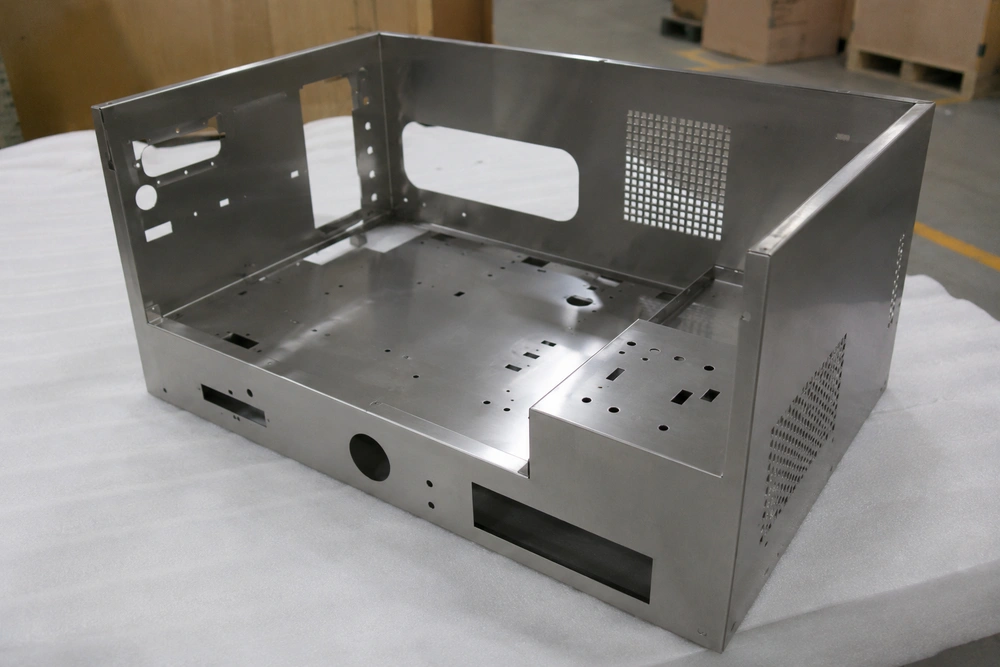
As a metal bending supplier, we offer a wide range of services that are relevant not only on Earth but also have potential applications in space - related projects. We provide Precision CNC Bending Sheet Metal Fabricated Parts OEM ODM. Our CNC bending machines are highly accurate and can produce complex shapes with tight tolerances. These machines can be adapted to work in a space - like environment with the right modifications.
We are also a CNC Machining Precise Sheet Metal Bending Manufacturer in China. Our expertise in CNC machining allows us to produce high - quality metal parts that can be used in space applications. Whether it's for building spacecraft components or space station structures, our precision - bent metal parts can meet the strict requirements of space projects.
In addition, we offer Precision Forming Galvanized Sheet Metal Forming Process Custom. Galvanized sheet metal is highly resistant to corrosion, which is an important property in the harsh space environment. Our custom - forming process can create unique shapes that are tailored to the specific needs of space projects.
The Future of Metal Bending in Space
The future of metal bending in space is full of possibilities. As space exploration continues to expand, there will be an increasing need for on - site manufacturing capabilities. Being able to bend metal in space will be crucial for building and maintaining structures in space, such as space stations, lunar bases, or even interstellar spacecraft.
Our company is committed to researching and developing new metal bending technologies that can be used in space. We are constantly exploring ways to adapt our existing processes to the unique challenges of the space environment. By collaborating with space agencies and research institutions, we hope to contribute to the advancement of space - based manufacturing.
Contact Us for Your Metal Bending Needs
Whether you are working on a space - related project or have a terrestrial metal bending requirement, we are here to help. Our team of experts has the knowledge and experience to provide you with the best metal bending solutions. If you are interested in our services, please feel free to contact us for a consultation. We look forward to discussing your project and finding the right metal bending solution for you.
References
- "Fundamentals of Metal Forming" by Y. Altan, G. Tekkaya, and N. Çaydas
- "Spacecraft Design and Engineering" by James R. Wertz and Wiley J. Larson
- Research papers on space manufacturing and metalworking from NASA and other space agencies