


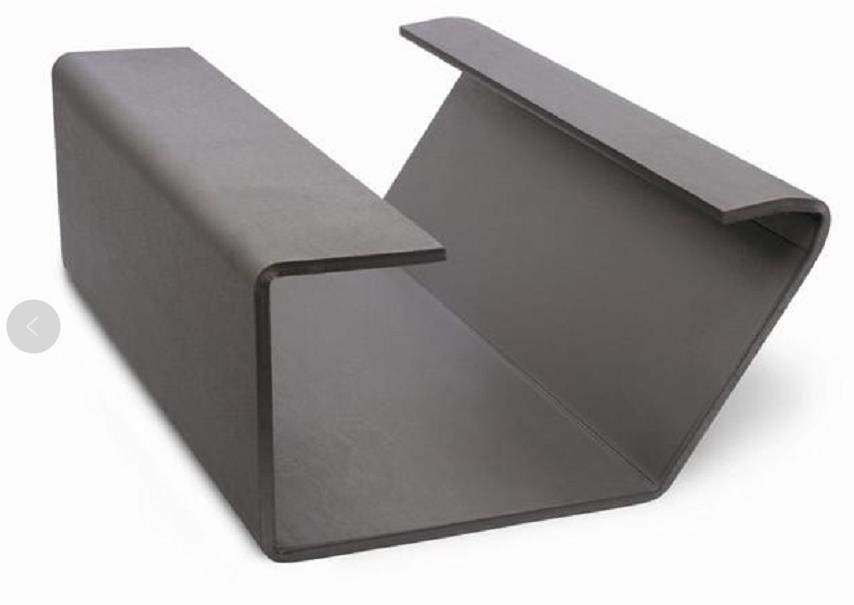
The sheet metal bending process refers to the processing of changing the angle of a sheet or a panel. (for example, bending a sheet into a V shape, a U shape, etc.)
The bending deformation of the V-shaped sheet bending member will be described as an example. The processing is:
The punching movement contact sheet (blank) generates bending short moment due to the different contact point forces of the convex and concave molds, and elastic deformation occurs under the bending moment to produce bending;
As the punch continues to descend, the surface of the blank and the die gradually approach, so that the bending radius and the bending arm are reduced. The contact point between the blank and the die is moved from the shoulder of the die to the two inclined faces of the die (plastic) Change the beginning phase);
As the punch continues to descend, the two ends of the blank contact the convex slope of the blank to start bending (return bending stage);
During the flattening stage, as the gap between the convex and concave molds becomes smaller, the sheet is flattened between the convex and concave molds;

The sheet metal bending process, as an important part of the sheet metal processing process, lists the problems encountered in the five sheet metal bending processes and the methods to deal with them.
First: the cause of the deformation of the hole caused by the bending:
When the elastic bending is performed and the hole is positioned, the outer side of the curved arm is pulled due to the friction of the surface of the concave mold and the outer surface of the workpiece, and the positioning hole is deformed.
Solution: Use shape bending. Increase the pressure of the top plate. A plaque is added to the top plate to increase the friction to prevent the part from slipping during bending.
Second: the bending edge is not straight, the reason for the size is unstable:
The design process did not arrange for crimping or pre-bending. The material is not strong enough. The unevenness of the convex and concave molds is asymmetrical or the bending force is uneven. The height is too small.
Solution: Arrange the design of the press line or pre-bending process. Increase the pressing force. The convex and concave molds have uniform gaps and rounded corners. The height dimension cannot be less than the minimum limit size.
Third: the reason why the bending angle has cracks:
The inner radius of the bend is too small. The material grain direction is parallel to the bending line. The burrs of the blank are outward. Metal plasticity is poor.
Solution: Increase the bending radius of the punch. Change the blanking layout. The burr is changed to the fillet in the workpiece. Annealed or using a soft material.
Fourth: the cause of the external surface scratch after the workpiece is bent:
The surface of the raw material is not smooth. The bending radius of the punch is too small. The bending gap is too small.
Solution: Improve the smoothness of the convex and concave molds. Increase the bending radius of the punch. Adjust the bending gap.
Fifth: Reasons for thinning of the curved surface extrusion material:
The die fillet is too small. The gap between the convex and concave molds is too small.
Solution: Increase the radius of the die corner. Correct the gap between the convex and concave molds.


