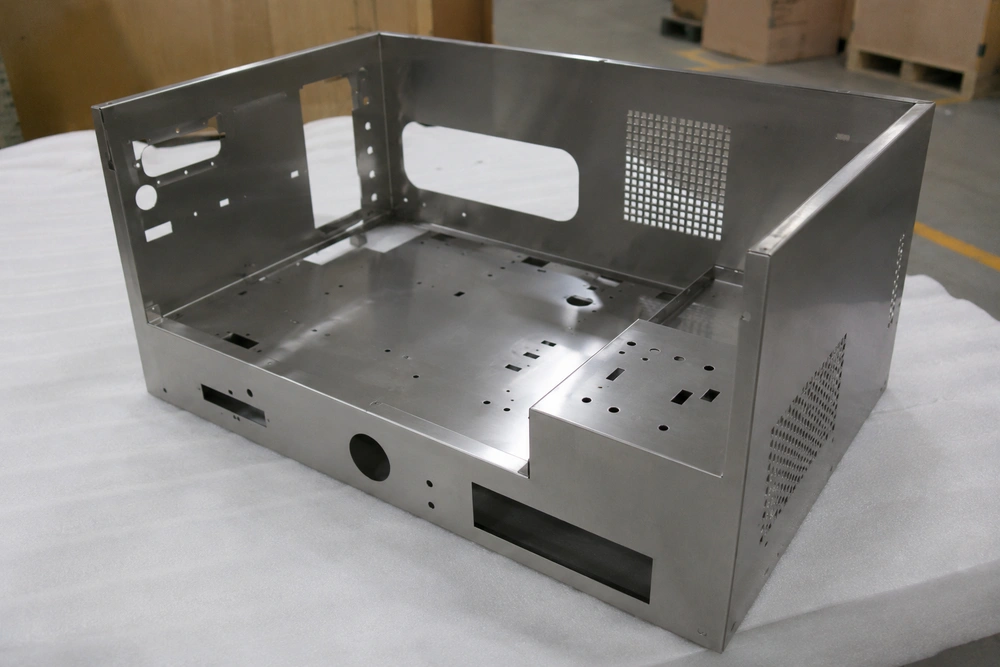

Hey there! I'm a supplier in the metal fabrication business, and today I wanna chat about the requirements for metal fabrication drawings. These drawings are super important as they're like the roadmap for our whole fabrication process.


Clear Dimensions and Tolerances
First off, one of the most crucial things in metal fabrication drawings is clear dimensions. You gotta be precise about how big or small each part of the metal piece should be. For example, if we're making a custom bracket for an industrial heat exchanger, the length, width, and height of the bracket need to be clearly marked. There's no room for guesswork here. A small error in dimensions can lead to a part that doesn't fit where it's supposed to.
Along with dimensions, tolerances are equally important. Tolerance is the acceptable amount of variation in a dimension. Let's say the drawing specifies a length of 100 mm with a tolerance of ±0.5 mm. That means the actual length of the fabricated part can be anywhere from 99.5 mm to 100.5 mm and still be considered within spec. Without clear tolerance information, we might end up with parts that are either too loose or too tight when assembled. This is especially important in projects like the Best Service Industrial Heat Exchanger Steel Work Metal Roof Support Bracket Custom Metal Bracket Fabrication, where precision is key for proper functionality.
Material Specification
Another vital requirement is the material specification. The drawing should clearly state what type of metal is to be used. Is it stainless steel, carbon steel, aluminum, or something else? Different metals have different properties, such as strength, corrosion resistance, and machinability. For instance, if we're making a Custom Modern Design Reusable Metal Bread Box Bin Storage Food Tiffin Bento Stainless Steel Kids Children's Lunch Box Container, stainless steel is a great choice because it's hygienic and resistant to rust. The drawing should also mention the grade of the metal, like 304 or 316 stainless steel, as different grades have different chemical compositions and performance characteristics.
Geometric Tolerancing
Geometric tolerancing is often overlooked but is extremely important in metal fabrication. It defines the allowable variation in the shape, orientation, and location of features on a part. For example, if a part has a hole that needs to be perpendicular to a surface within a certain degree of tolerance, the drawing should clearly show this. Geometric tolerancing ensures that the parts fit together correctly and function as intended. In complex fabrication jobs like those involving multiple parts that need to be assembled precisely, geometric tolerancing can make or break the project.
Manufacturing Process Indications
The drawing should also give some indications about the manufacturing processes to be used. For example, if a part needs to be cut using a laser cutter and then bent, the drawing should mention this. This helps us plan our production process more efficiently. If we're doing Bending Laser Cut CNC Fabrication Custom, the drawing should clearly show where the laser cutting should occur and the angles and dimensions for the bending operations.
Surface Finish Requirements
Surface finish is another aspect that should be specified in the drawing. The surface finish can affect the appearance, corrosion resistance, and functionality of the part. For example, a part that will be exposed to the elements might need a smooth, polished finish to prevent corrosion. On the other hand, a part that will be used in a high - friction environment might need a rougher finish for better grip. The drawing should state the required surface roughness value, which is usually measured in micrometers or microinches.
Assembly and Joining Details
If the fabricated parts need to be assembled, the drawing should provide details about how the parts are to be joined. This could be through welding, bolting, riveting, or other methods. The drawing should show the location, size, and type of fasteners or welds. For example, if two metal plates need to be welded together, the drawing should show the weld type (e.g., fillet weld or butt weld), the weld size, and the welding process (e.g., MIG or TIG). Clear assembly and joining details ensure that the final product is strong and functional.
Annotation and Notes
Finally, the drawing should have clear annotations and notes. These can be used to provide additional information that might not fit neatly into the dimensioning or other symbols on the drawing. For example, a note might say that a certain area of the part should be free of burrs or that a specific heat treatment is required after fabrication. Annotations and notes help us understand all the requirements and ensure that the final product meets the customer's expectations.
In conclusion, getting the requirements right in metal fabrication drawings is crucial for a successful project. Clear dimensions, material specifications, geometric tolerancing, manufacturing process indications, surface finish requirements, assembly details, and annotations all play important roles. If you're in need of high - quality metal fabrication services, we're here to help. Whether it's a simple bracket or a complex custom - designed product, we've got the expertise and equipment to get the job done right. So, if you're interested in starting a project, don't hesitate to reach out for a quote and let's start the conversation about bringing your metal fabrication ideas to life.
References
- ASME Y14.5 - 2018, Dimensioning and Tolerancing
- ISO 1101:2017, Geometrical product specifications (GPS) — Geometric tolerancing — Tolerances of form, orientation, location and run - out